
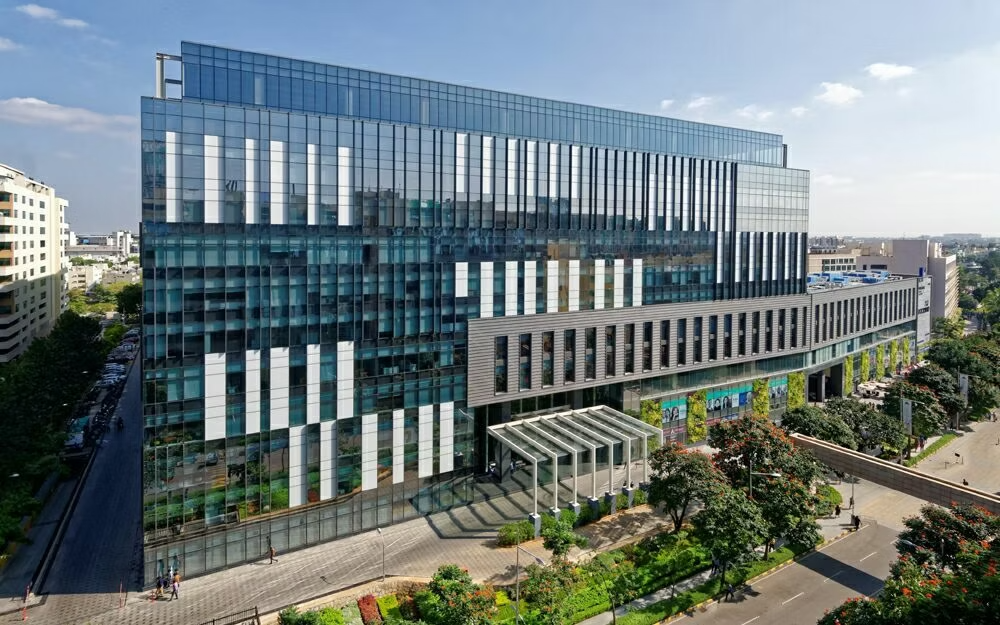
India’s urban skyline is changing rapidly. From commercial towers and IT parks to hotels, hospitals, airports, premium residences, and mixed-use developments, modern buildings are demanding façades that are faster to install, safer to execute, and more consistent in quality.
This is where unitized curtain wall systems are becoming increasingly important. Unlike traditional stick glazing systems, where most of the assembly takes place at site, unitized curtain wall panels are largely fabricated and glazed in a controlled factory environment before being transported to site for installation.
For fast-growing construction markets like India, this approach offers major advantages in speed, quality, safety, and long-term performance.
1. What Is a Unitized Curtain Wall System?
A unitized curtain wall system is a façade system made up of pre-assembled panels, also called units or modules. These panels generally include aluminium framing, glass, gaskets, brackets, anchors, spandrel areas, insulation, and other accessories depending on the project design.
Once manufactured and inspected in the factory, the completed panels are delivered to site and installed floor by floor using cranes, monorails, winches, or other lifting systems. This reduces the amount of fabrication, glazing, sealing, and alignment work required at site.
In simple terms, unitized systems shift a large part of façade work from the construction site to the factory.
2. Why Unitized Systems Are Important for India
India’s building façade market is growing strongly. According to IMARC Group, the India building façade market was valued at USD 8.66 billion in 2025 and is projected to reach USD 15.81 billion by 2034, growing at a CAGR of 6.91% during 2026–2034. This growth is being driven by urbanisation, commercial development, infrastructure expansion, and demand for modern building envelopes.
As Indian cities continue to grow vertically, façade execution has become more complex. High-rise buildings require systems that can handle wind pressure, thermal movement, water penetration, installation tolerances, and safety requirements. Unitized curtain wall systems are well-suited for these demands because they offer better control over fabrication and installation quality.
3. Faster Installation on High-Rise Projects
One of the biggest advantages of unitized curtain walls is speed. Since the panels are pre-assembled in the factory, site installation becomes faster and more systematic. This is especially useful in Indian metro cities where project timelines are tight and site conditions are often congested.
In cities such as Mumbai, Pune, Bengaluru, Hyderabad, Delhi NCR, Ahmedabad, and Chennai, construction sites often face labour constraints, limited storage space, traffic restrictions, monsoon interruptions, and high safety expectations. Unitized systems help reduce site activity and improve installation planning.
4. Better Quality Through Factory-Controlled Production
Quality control is a major reason why global high-rise projects prefer unitized curtain walls. Factory production allows better inspection of aluminium profiles, glass bonding, gasket fixing, sealant application, bracket assembly, and dimensional accuracy.
Compared to site-based glazing, factory conditions offer better control over cleanliness, temperature, curing time, handling, and workmanship. This improves the overall performance of the façade and reduces the risk of leakage, alignment issues, glass damage, and inconsistent finishing.
Industry references commonly highlight speed, lower field installation work, and better quality control as key advantages of unitized curtain wall systems.
5. Improved Safety at Site
Façade installation involves work at height, heavy glass handling, external access, lifting equipment, and coordination with multiple agencies. In traditional systems, more work is carried out on scaffolding, cradles, or external platforms.
Unitized systems reduce the amount of manual work performed at height because the panels arrive at site in a more complete form. This helps improve safety, reduces exposure time for workers, and supports a more organised installation sequence.
For Indian high-rise projects, where safety compliance is becoming increasingly important, this is a major benefit.
6. Better Performance for Indian Climate Conditions
India has diverse climate conditions, from hot and dry regions to coastal humidity, heavy monsoon zones, high pollution areas, and strong solar exposure. A well-designed unitized façade can help address these conditions through proper glass selection, drainage design, pressure equalisation, thermal breaks, gaskets, and tested system detailing.
For commercial and hospitality buildings, this can improve indoor comfort, reduce heat gain, support energy efficiency, and enhance the building’s long-term durability.
7. Challenges to Consider
While unitized curtain wall systems offer many advantages, they require strong planning. Accurate shop drawings, structural calculations, procurement coordination, factory setup, skilled manpower, logistics planning, and lifting methodology are essential.
The system also requires higher upfront coordination compared to simpler façade systems. However, for large buildings and high-rise projects, the benefits of speed, quality, safety, and performance often justify the investment.
Conclusion
Unitized curtain wall systems represent the future of high-performance façade construction in India. As Indian cities continue to build taller, faster, and more complex structures, the demand for factory-assembled façade systems will continue to rise.
For developers and architects, unitized façades offer a practical way to achieve better quality, faster execution, safer installation, and improved building performance.
At MEIA Facade, we see unitized curtain wall systems as an important step towards more advanced, efficient, and globally aligned façade construction in India.


Leave a Reply